
1. What Is Mutual Divorce in India?
Mutual divorce — formally called Divorce by Mutual Consent — is a legal mechanism that allows a husband and wife who jointly agree their marriage has broken down irreparably to dissolve it through a simplified court process. Neither spouse has to prove fault, cruelty, or desertion. There is no blame game. Both parties simply acknowledge that continuing the marriage is impossible and that they have settled all outstanding issues between themselves.
The concept rests on three pillars:
- Mutual Agreement: Both spouses willingly consent to the divorce at every stage — no coercion permitted.
- Prior Settlement: Alimony, child custody, maintenance and property division are agreed upon before or at the time of filing.
- Judicial Confirmation: A Family Court judge records the consent, checks its genuineness, and issues the divorce decree.
India’s courts have increasingly favoured this route. According to data compiled from various High Court annual reports, mutual consent petitions now constitute an estimated 55–60% of all divorce filings in metropolitan Family Courts, reflecting a nationwide shift toward non-adversarial separation.
2. Legal Framework — Which Law Applies to You?
India has no single uniform divorce law. The applicable legislation depends on the religion in which the marriage was solemnized. Here is a quick reference:
| Religion / Marriage Type | Governing Law | Key Section |
|---|---|---|
| Hindus, Sikhs, Buddhists, Jains | Hindu Marriage Act, 1955 | Section 13B |
| Inter-faith / Civil marriages | Special Marriage Act, 1954 | Section 28 |
| Christians | Indian Divorce Act, 1869 | Section 10A |
| Parsis | Parsi Marriage and Divorce Act, 1936 | Applicable provisions |
| Muslims | Muslim Personal Law + Dissolution of Muslim Marriages Act, 1939 | Khul' / Mubarat |
For the vast majority of Indians, Section 13B of the Hindu Marriage Act, 1955 is the primary provision. All further steps in this guide are based on Section 13B, with notes where other laws differ significantly.
⚖️ Important Legal Note
NRIs and overseas Indians married in India can also file under the applicable Indian personal law through the Family Court of their last shared domicile in India, or through the Indian embassy in limited circumstances.
3. Eligibility Criteria for Mutual Divorce
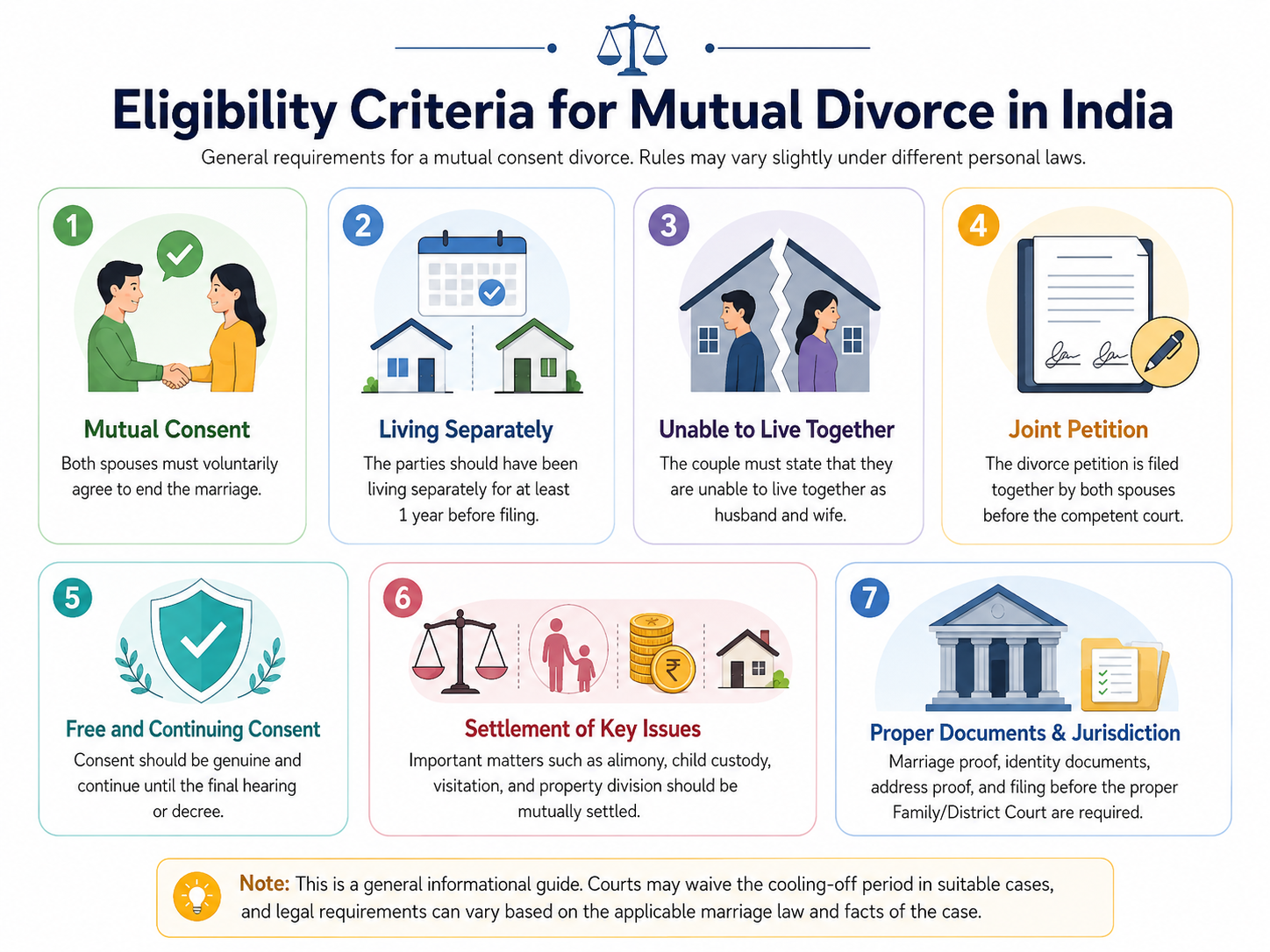
Before filing, both spouses must satisfy all of the following conditions under Section 13B of the Hindu Marriage Act:
- Minimum Separation of One Year: The couple must have lived separately for at least one year immediately before filing the petition. Crucially, “living separately” does not always mean physically living in different homes — courts have accepted emotional separation, where the couple no longer cohabits as husband and wife, even under the same roof.
- Inability to Live Together: Both spouses must affirm that reconciliation is not possible and there is no realistic prospect of resuming the marital relationship.
- Mutual and Free Consent: Both parties must give their consent willingly, free from any pressure, coercion, undue influence or fraud.
- Prior Settlement of All Issues: Matters such as permanent alimony, child custody, visitation rights, child maintenance and division of matrimonial property must be agreed upon before or at the time of filing.
- Jurisdictional Requirements: The petition must be filed at the Family Court of the district where the marriage took place, where the parties last lived together, or where either spouse currently resides.
🏛️ Latest Supreme Court Update — 2025
In a landmark December 2025 ruling, the Delhi High Court held that the one-year mandatory separation period under Section 13B(1) is directory — not absolutely mandatory — and can be relaxed in exceptional hardship cases where the marriage has clearly broken down with no chance of revival. This mirrors the 2017 Supreme Court ruling in Amardeep Singh v. Harveen Kaur on the cooling-off period.
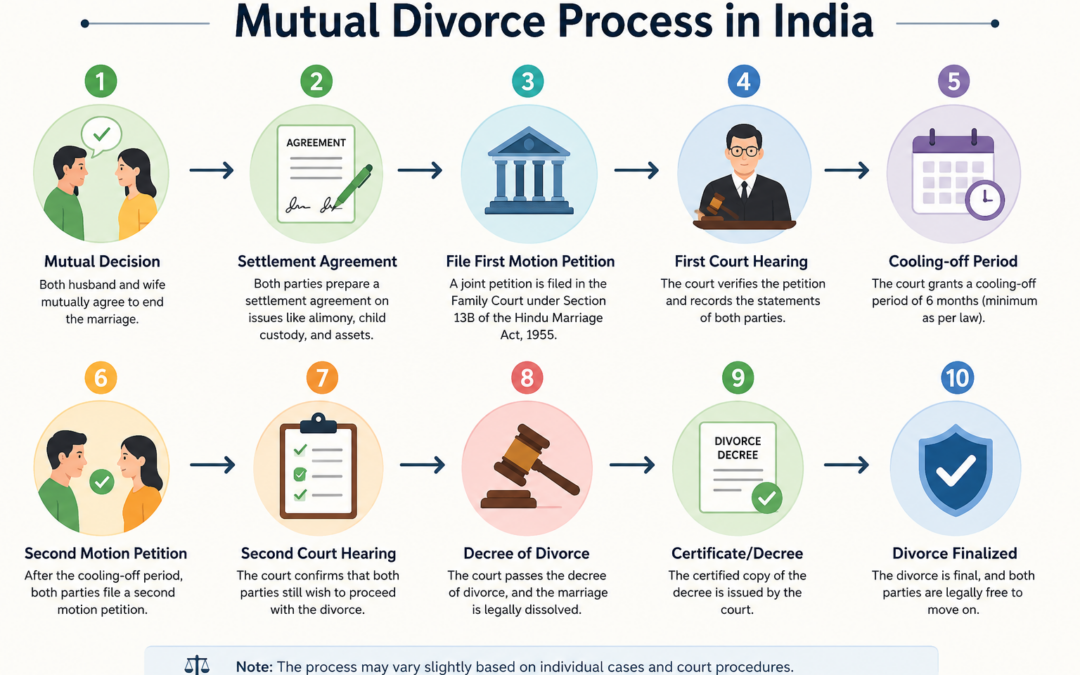
4. The 5-Step Mutual Divorce Process in India
The entire mutual divorce process follows a structured two-motion system. Here are the five key stages:
Draft the Settlement Agreement (MoU)
Before approaching the court, both spouses — ideally with independent legal counsel — prepare a detailed Memorandum of Understanding (MoU) covering alimony amount and mode of payment, child custody arrangements (primary and visitation), child maintenance quantum, division of all matrimonial property (residential property, investments, joint accounts, jewellery), and return of stridhan. This document forms the backbone of the petition and should be watertight to prevent future disputes.
File the Joint Petition — First Motion
Both spouses (or their authorised lawyers) jointly file the mutual consent divorce petition at the competent Family Court. The petition must be signed by both parties and accompanied by the MoU, all required documents, and prescribed court fees. The court issues a date for the first motion hearing, typically within 2–4 weeks of filing.
First Motion Hearing
At the first motion hearing, the Family Court judge examines the petition, reads the settlement agreement, and individually records the sworn statements of both spouses. The judge verifies that both parties are acting voluntarily and fully understand the implications of divorce. Once satisfied, the court admits the petition and formally records the First Motion. The six-month cooling-off period begins from this date.
Cooling-Off Period (6 Months — May Be Waived)
Section 13B(2) provides a mandatory six-month waiting period between the first and second motions, intended to give couples a final opportunity to reconsider. However, following the Supreme Court’s ruling in Amardeep Singh v. Harveen Kaur (2017), courts may waive this period entirely if both parties jointly apply, demonstrating that reconciliation is genuinely impossible. Many High Courts — including Gujarat, Delhi, and Bombay — have consistently upheld this waiver. If not waived, the second motion must be filed within 18 months of the first motion, or the petition lapses.
Second Motion Hearing & Divorce Decree
Both spouses appear before the court for the second motion hearing. The judge re-records their statements to confirm their consent remains unchanged and unretracted. Once the court is satisfied, it passes the Decree of Divorce — the legally binding document that dissolves the marriage. Both spouses receive certified copies of this decree, which they must preserve for all future legal purposes including remarriage.
5. Documents Required for Mutual Divorce
Filing an incomplete petition is one of the most common causes of delay. Ensure every document is in order before you approach the court:
Mandatory Documents
- Original Marriage Certificate — issued by the registrar or the religious institution where the marriage was solemnized.
- Address Proof of Both Spouses — Aadhaar card, passport, voter ID, or utility bills (not older than 3 months).
- Identity Proof — PAN card, Aadhaar, or passport of both spouses.
- Passport-Size Photographs — recent photographs of both husband and wife (typically 4 each).
- Proof of Separate Residence / Living Apart — rent agreements, utility bills in individual names, bank statements showing different addresses, employer letters, or any documentary evidence confirming separate living for at least one year.
- Income Proof — latest salary slips, ITR (last 2–3 years), Form 16, or business profit/loss statements — critical for calculating alimony.
- Signed Settlement Agreement (MoU) — covering alimony, child custody, property division, and any other agreed terms.
Additional Documents (Where Applicable)
- Children’s birth certificates and school records (if children are involved).
- Title deeds and property documents for all jointly owned or disputed assets.
- Bank account statements, fixed deposit records, investment portfolio statements.
- List of movable assets — vehicles, jewellery, household valuables.
- NRI-specific documents: visa, passport, foreign address proof, power of attorney if appearing through counsel.
6. The Cooling-Off Period — And How Courts Can Waive It
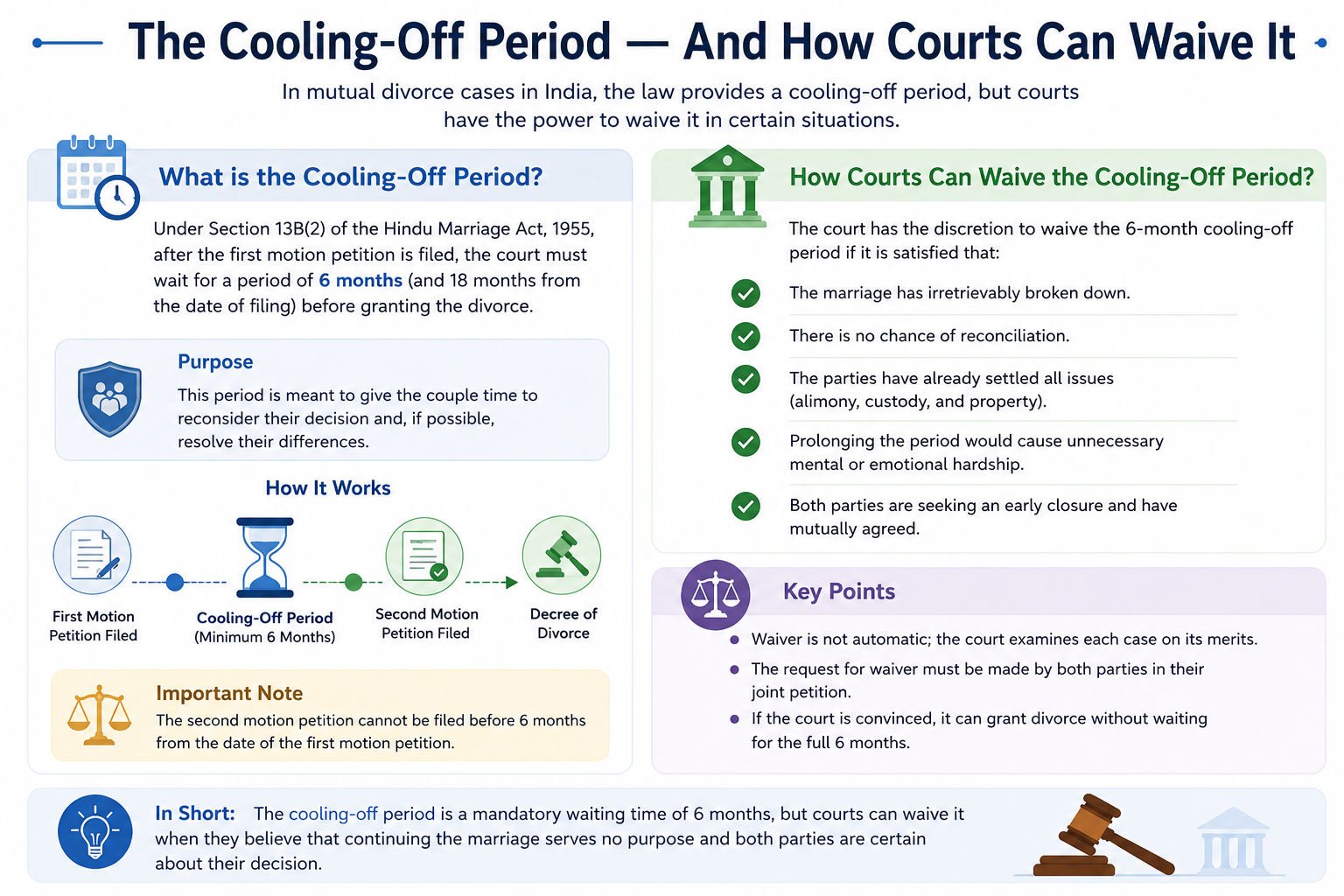
The six-month cooling-off period under Section 13B(2) was originally introduced to prevent hasty divorces and encourage reconciliation. In practice, however, for many couples who have already been living apart for years, this waiting period simply prolongs suffering without serving any meaningful purpose.
The Supreme Court of India in Amardeep Singh v. Harveen Kaur (2017) authoritatively settled this issue. The court held that the six-month cooling-off period is directory in nature — meaning it is a guideline, not an absolute mandate — and that the Family Court has the discretion to waive it when:
- Both spouses jointly apply for a waiver.
- The court is satisfied that all issues — alimony, custody, property — have been fully and fairly settled.
- The parties have already been living separately for a sufficiently long period.
- There is zero realistic prospect of reconciliation.
Following this ruling, High Courts across India — including Delhi (December 2025), Gujarat, Bombay, Rajasthan and Madras — have consistently applied the waiver in appropriate cases. If you wish to apply for a waiver, file a separate joint application along with your second motion petition, supported by an affidavit from both spouses.
7. Alimony, Child Custody & Property Settlement
Alimony (Permanent Alimony)
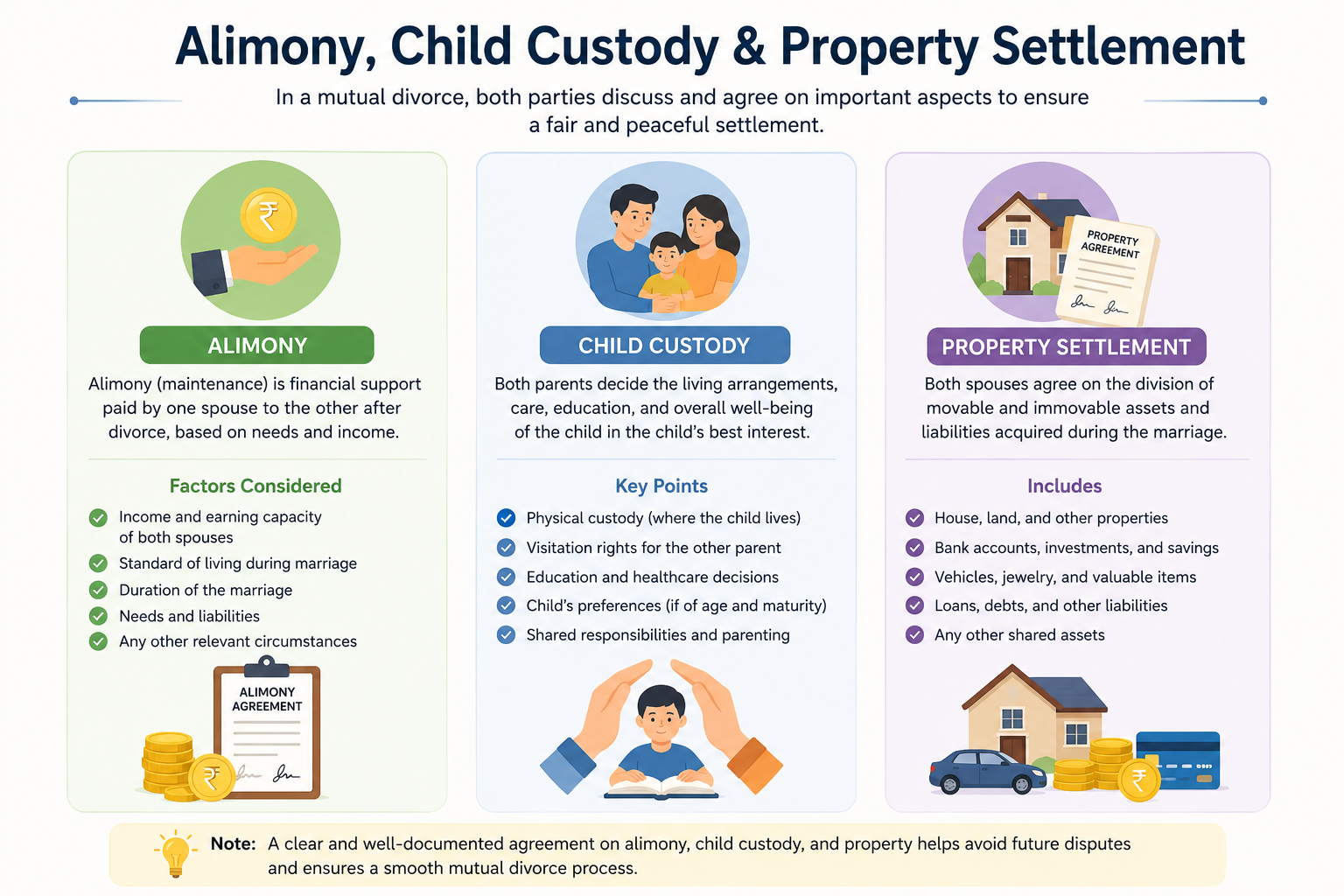
In a mutual divorce, the amount and terms of alimony (also called permanent alimony or maintenance) are entirely negotiable between the parties. There is no fixed formula. Courts will, however, scrutinize any settlement that appears grossly unfair to one party. Key factors considered include:
- The income and earning capacity of both spouses.
- The standard of living maintained during marriage.
- The age, health, and financial obligations of each spouse.
- Duration of the marriage.
- Whether either spouse has primary custody of children.
Alimony may be paid as a one-time lump sum or in monthly installments. A lump sum settlement is generally cleaner and avoids future disputes — especially recommended in mutual divorces.
Child Custody
The welfare of the child is the paramount consideration — courts will not approve any arrangement that is demonstrably against the child’s best interests, even in a mutual divorce. Typical arrangements include:
- Primary Custody — the child lives primarily with one parent.
- Visitation Rights — clearly defined timelines for the non-custodial parent (weekends, school holidays, festivals, vacations).
- Shared Parenting — the child splits time between both parents on an agreed schedule.
- Child Maintenance — a fixed monthly amount payable by the non-custodial parent, reviewable if circumstances change.
Property Division
India does not have a community property regime — matrimonial property is not automatically divided 50/50. Each asset must be specifically addressed in the settlement agreement, covering jointly owned real estate, bank accounts, fixed deposits, mutual funds, shares, insurance policies, vehicles, and stridhan (jewellery, gifts given to the wife at the time of marriage).
8. Realistic Timeline & Cost of Mutual Divorce
⏱ How Long Will It Take?
If the cooling-off period is waived, and the court schedule permits, a mutual divorce can be concluded in as little as 3–5 months from the date of filing.
Typical timeline: 6 to 18 months, accounting for the six-month cooling-off period and routine court scheduling.
Maximum: The second motion must be filed within 18 months of the first motion. If this deadline is missed, the entire petition lapses and the couple must start again from scratch.
- Court Filing Fees: Typically ₹500 to ₹2,000, varying by state and court.
- Lawyer Fees: Range from ₹15,000 to ₹2,00,000+ depending on city, complexity, and seniority of advocate. Delhi, Mumbai, and Bangalore tend to be at the higher end.
- Notarization & Stamp Duty: ₹500 to ₹5,000 for notarizing the MoU and affidavits.
- Miscellaneous: Photocopying, courier, travel to court — typically ₹2,000 to ₹5,000.
A straightforward mutual divorce in a Tier-2 or Tier-3 city with a competent local lawyer can cost as little as ₹25,000–₹50,000 all-inclusive. In metropolitan cities, budget ₹75,000 to ₹2,50,000 depending on the complexity of asset settlement.
9. Common Mistakes That Delay Mutual Divorce
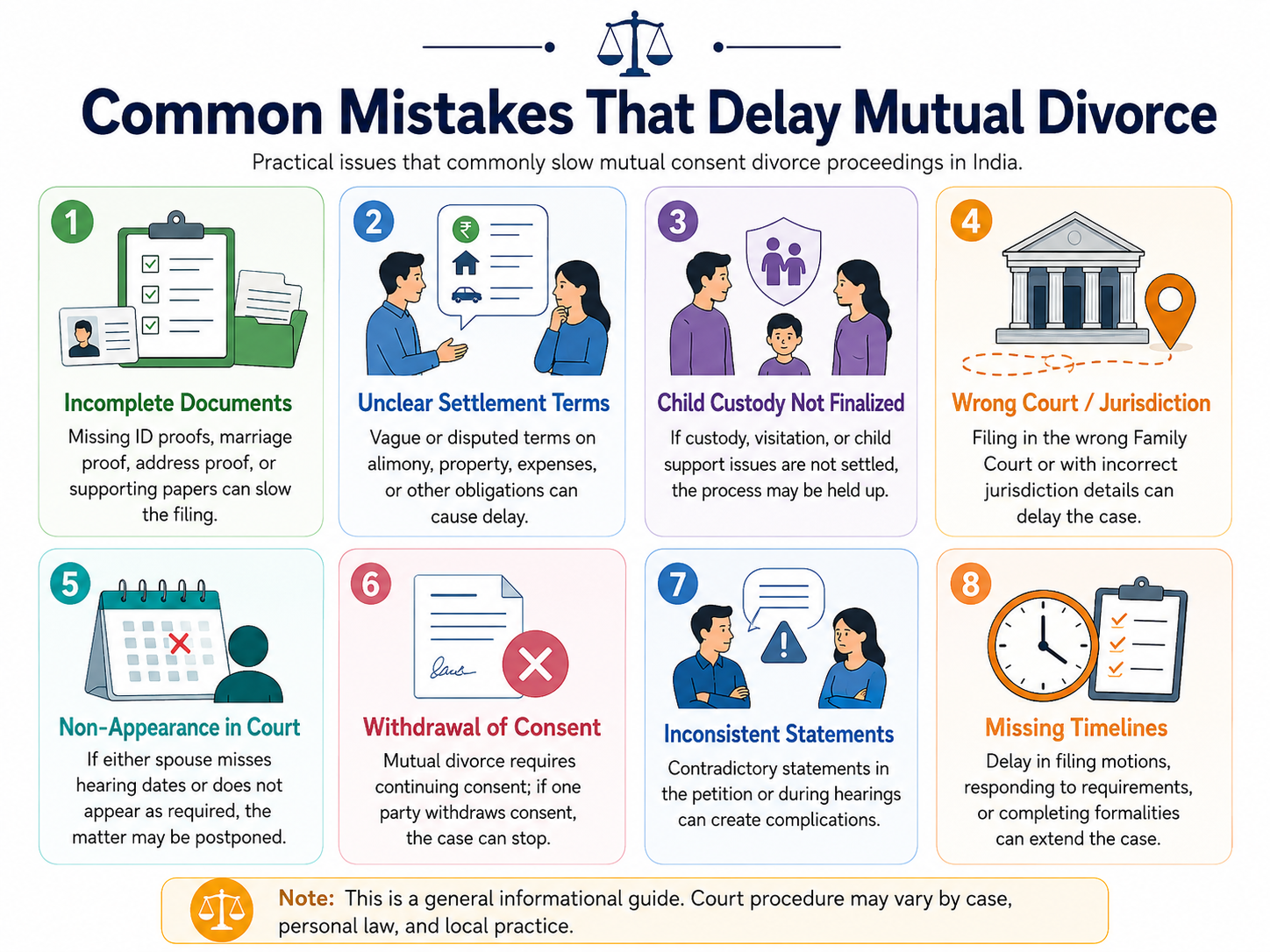
- Vague or Incomplete Settlement Agreement: Every asset, every payment, every custody arrangement must be specified in writing. Ambiguity leads to post-divorce litigation.
- Missing the 18-Month Second Motion Deadline: If either party fails to appear for the second motion within 18 months, the petition is deemed withdrawn and you must refile.
- Withdrawing Consent Unilaterally: Either spouse can withdraw consent before the second motion is recorded. Courts have held that silence alone does not equal withdrawal — but any genuine withdrawal before the second motion results in the petition being dismissed.
- Filing in the Wrong Court: Jurisdiction matters. File only in the Family Court of your last shared marital home, your place of marriage, or your current residence.
- Incomplete Document Set: Missing or incorrect documents cause adjournments that can delay the process by months.
- Not Accounting for Future Contingencies: Failing to include clauses on what happens if either party defaults on alimony payments or violates custody arrangements.
10. Frequently Asked Questions (FAQ)
What is the minimum separation required before filing mutual divorce in India?
Couples must have lived separately for at least one year before filing a petition under Section 13B of the Hindu Marriage Act, 1955. Courts interpret “living separately” broadly — physical separation of households is ideal but not mandatory; what matters is that the couple has ceased to live together as husband and wife. In exceptional hardship cases, courts may waive this requirement following the December 2025 Delhi High Court ruling.
Can the six-month cooling-off period be waived?
Yes. Following the Supreme Court’s landmark ruling in Amardeep Singh v. Harveen Kaur (2017), the six-month cooling-off period under Section 13B(2) has been held to be directory (not mandatory). Courts across India — including in Delhi, Gujarat, Bombay, and Madras — routinely waive it when both parties jointly apply, confirming that all issues are settled and reconciliation is impossible.
Can one spouse withdraw consent after the first motion?
Yes — either spouse can withdraw their consent at any point before the second motion is recorded by the court. This will result in the mutual divorce petition being dismissed. The matter would then need to proceed as a contested divorce if one spouse still wishes to separate. Courts have held that mere silence does not constitute withdrawal of consent — a positive act or communication is required.
Do both spouses have to appear in court personally?
Generally, yes — personal appearance is required at both the first and second motion hearings so the court can record individual statements and verify consent directly. However, many courts now permit video-conferencing for NRIs and those who are physically unable to appear, subject to the court’s discretion and the filing of appropriate applications in advance.
Can we get mutual divorce without a lawyer?
Technically yes — parties can appear in person (in propria persona). However, this is strongly inadvisable. A lawyer ensures the petition is correctly drafted, the MoU is watertight, documents are in order, court appearances are properly managed, and your legal rights are fully protected. A poorly drafted settlement agreement can result in costly post-divorce disputes that cost far more than a lawyer’s fee.
What happens to children in a mutual divorce?
The welfare of the child remains paramount. In a mutual divorce, parents agree on custody, visitation schedules and child maintenance in the settlement agreement (MoU). Courts will approve these arrangements only if they are genuinely in the child’s best interests. If the court finds the arrangement detrimental to the child, it may require modification even in a mutual divorce proceeding.
Can we remarry after a mutual divorce decree?
Yes — once the divorce decree is issued, both parties are legally free to remarry. You will need a certified copy of the divorce decree for the marriage registration process. Under Section 15 of the Hindu Marriage Act, there is no mandatory waiting period before remarriage following a mutual consent divorce (unlike some contested divorce scenarios).
Conclusion
The mutual divorce process in India, while multi-step, is designed to be as humane and efficient as possible for couples who have genuinely agreed to part ways. With the right preparation — a thorough settlement agreement, a complete set of documents, experienced legal counsel, and a clear understanding of the two-motion procedure — most couples can complete the process smoothly within 6 to 12 months.
The evolving jurisprudence from the Supreme Court and various High Courts in 2025 has further streamlined the process: courts are increasingly willing to waive mandatory waiting periods when a marriage is clearly beyond repair, recognizing that prolonging legal agony serves no one.
If you are considering a mutual divorce, the single most important step is getting an airtight settlement agreement in place before you file. Invest time and money in a competent family lawyer — it will save you both exponentially more time and money in the years ahead.
⚠️ Disclaimer
This article is for general educational and informational purposes only and does not constitute legal advice. Indian family law is complex, jurisdiction-specific, and subject to change through judicial decisions and legislative amendments. Always consult a qualified family law advocate licensed in your jurisdiction before taking any legal steps.